
FLOOD!
The Great Tragedy Of 1953

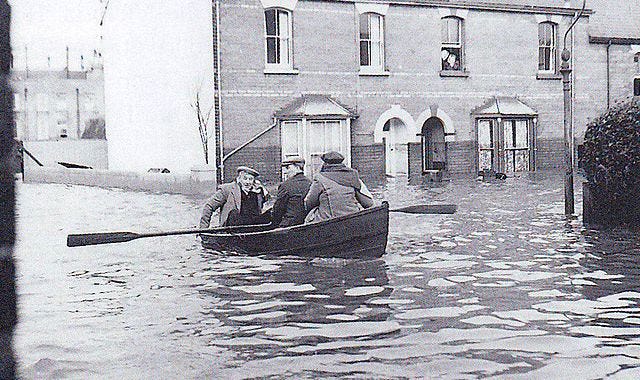
Escaping the devastation in Harwich (Wikipedia Commons)
In early 1953 the exposed eastern coast of the UK were affected by floods that, at the time and in their immediate aftermath, came to be described as the worst peacetime disaster to ever hit this country.
It’s now over 72 years since those tragic events unfolded yet, for all the passing of time, memories are not so easily erased as sand dunes and cliff faces with many people’s recollections of that night and the devastation the floods wrought as fresh and clear as they were over six decades ago.
It had been an otherwise unremarkable Saturday in Norfolk, one that saw Norwich City, thanks to a goal from Johnny Gavin, earn a 1-1 draw against Coventry City at Carrow Road. It was a match that Snettisham PC Henry Nobbs uncharacteristically left early because, as he later explained, “...the ball was being blown into the air all the time and the players couldn’t control it...”
A prophetic PC.
In the wider world, Eddie Fisher, the Father of Star Wars actress Carrie was at number one in the charts with Outside Of Heaven whilst the local and national news was still focusing on the execution of Derek Bentley at Wandsworth Prison three days earlier for his alleged part on the murder of PC Sidney Miles.
Bleak news on a dark night. One that saw the North Sea experiencing its first spring tides of the year.
High tide are normally eye catching events in Norfolk. They get an audience. How many people have stood on the quay at Wells watching the tide creep over its edge or walked the built up footpath at Brancaster to see the beach road and surrounding salt marsh completely covered with water for an hour or so?
Few would have been interested on that night. It was cold, there was snow in the air and the wind, ever fresh, was picking up with a renewed chill and force.
Get in, shut the door, draw the curtains, keep warm and have a cosy evening as a family. The world can wait until the dawn. There’s no social media of course, no computers or tablets, and, for the great majority, no television either. But there is the radio and the long forgotten art of conversation.
Towns, villages and households were as much isolated islands as the nation they lived in.
Sheltered and alone. And waiting for the dawn. Which, for some, never came.
An area of low atmospheric pressure that had been steadily building up to the north of Scotland was now gathering speed and strength as it moved its way south east, down the North Sea coast and to the exposed coastal areas and flatlands off the Netherlands as well as Lincolnshire, Norfolk, Suffolk and Essex in then UK. The accompanying gales that battered that part of the coast en-route forced a great and unstoppable mass of sea water south at the time of high tide, meaning that a tidal surge, one that eventually measured nearly 6 metres (around 20 feet) above the average sea level, was rampaging its way down the east coast.
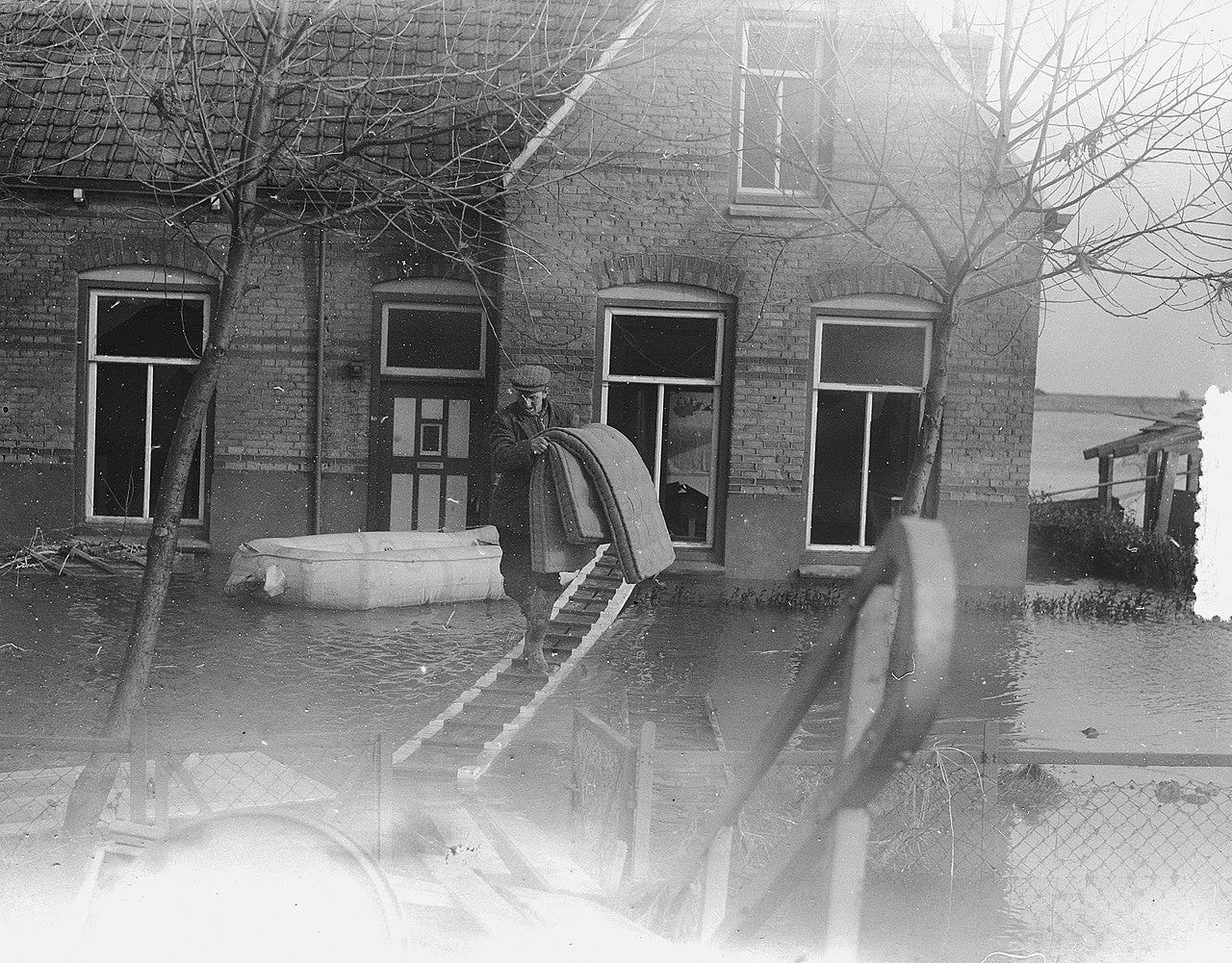
The low lying coastal areas of the Netherlands were also subject to damage and loss (Wikipedia Commons)
Twenty feet. Think about it. That’s about the height of an adult giraffe.
Now replace that image of a giraffe in your mind with that of a seething, pulsating mass of water at the same height. An unstoppable one that can bring down a building as easily as you or I can kick over a sandcastle.
It’s January 31st 1953. And if you live on the Norfolk coast, that wall of water is on its way to you.
That combination of the storm surge, the high spring tides, gale force winds and extremely large waves resulted in sea defences being completely and utterly overwhelmed. In many cases, it was if they had never been there at all. In England alone, 307 people were killed in those four counties mentioned whilst 1800 lost their lives in the Netherlands.
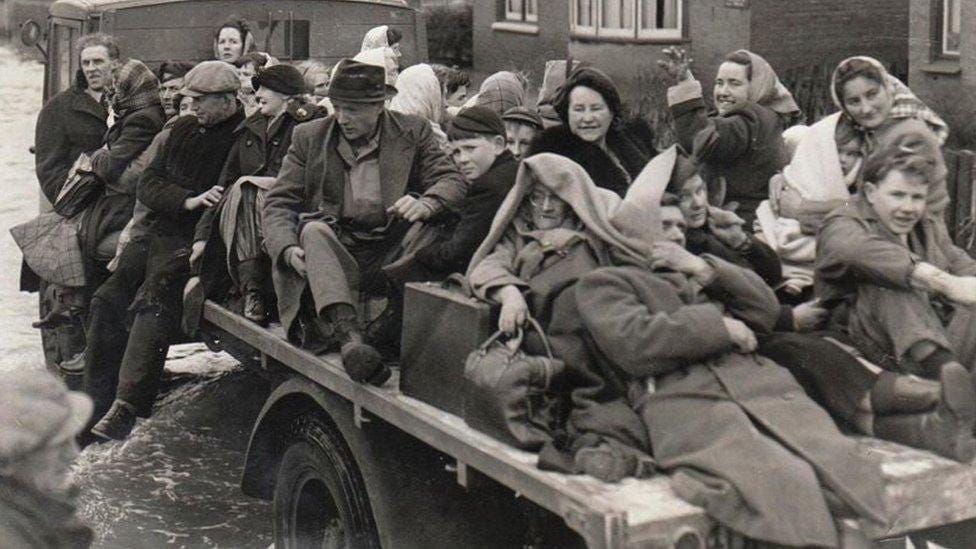
Whole communities had to be evacuated as seen here in Lincolnshire (LRF Archive)
That’s around half the entire population of present day Holt.
In Kings Lynn the surge of water flooded over the tops of the river Great Ouse’s harbour quays at 6:30pm, an hour after the first flood warnings had been sounded. That was the first instance of many people being made aware of the pending danger. And that’s if they had even heard them, sat in their homes, cocooned, with the radio on and the wind roaring outside.
For many, the first they would have known of the flood was when it burst in through their doors and windows.
Residents of Kings Lynn remember the streetlights of London Road exploding, one by one, as the water rose ever higher, plunging the entire area into darkness. Now the only lights came from torches, their beams haphazardly criss-crossing the inky skies as people searched for friends and neighbours, all the time trying to ignore whatever the static and lifeless things were that floated past them as they did so.
In South Lynn, fourteen elderly residents were unable to escape the fast rising floods and drowned in their homes whilst, at Sea Palling, seven people drowned when the sea broke through the defences there.
Hunstanton also received a merciless battering. The incoming tidal surge almost completely wrecked the town’s fairground whilst a train that was travelling on the now long closed railway line from Hunstanton to Kings Lynn had to be brought to a premature halt because debris from seaside bungalows had been swept onto the line. Thirty one people died in and around Hunstanton, sixteen of whom were serving USAF airmen billeted in the town. Whilst all this was happening, at Wells, sixteen miles east of Hunstanton, a 160 ton ship was washed up and onto the quayside after the waves effortlessly pushed it ashore, a sight that few who saw it will ever forget.
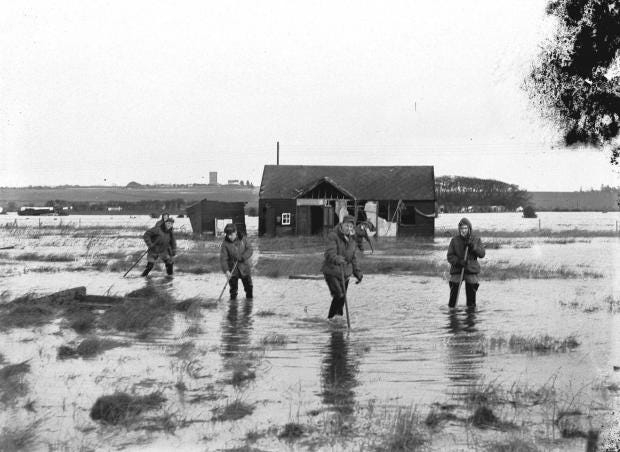
Searching for survivors between Heacham and Hunstanton (Newsquest)
The 1953 storm caused widespread damage and loss of life right along the Norfolk coast, from Kings Lynn in the west to Lowestoft on the Suffolk border. And it didn’t discriminate. Wooden bungalows, beach huts, chalets, caravans and vulnerable older properties and, in some cases, their equally vulnerable residents stood no chance against the rush of the storm, one that overwhelmed the counties sea defences, a storm that, if it was repeated this coming winter, would more than put their modern replacements to the test.
Why were so many lives lost? At a time when the mass and easy social and business communication that we take for granted today was not even a distant dream, many homes and communities had little to no idea of the approaching danger until it was sharing their village, street and home. And, by then, it would have been too late to do anything about it except wait, hope and, in many cases, perish.
Could it happen again? Yes, of course. And there have been some fierce and equally unrelenting storms since which, thankfully, have not left the mark that the 1953 flood did because we have, since then, not only seen significant upgrades to coastal defences but in the ways we are able to communicate approaching menace.
We will maybe never be so unprepared for the weather’s wrath again. But that does not mean we should be complacent.
_______________________
I have used images in this blog & credited appropriately on the understanding that they are all now ‘public domain’ images and permission is given. If, for any reason, use of any of these images is deemed by a rights owner as inappropriate, please advise me & I will will remove and replace your image. No intentional use of still copyrighted material is intended. Thankyou. Ed.